Fend four-color ballpoint pens and colored pencils
Fend Norma, Fend Super-Norma, Fend multi-color pencils
Stand: 03.03.2026
Achievements from the Fend brothers company from Pforzheim
- The most successful German multi-color pencil manufacturer.
- Spread of the locking sleeve automatic all over the world.
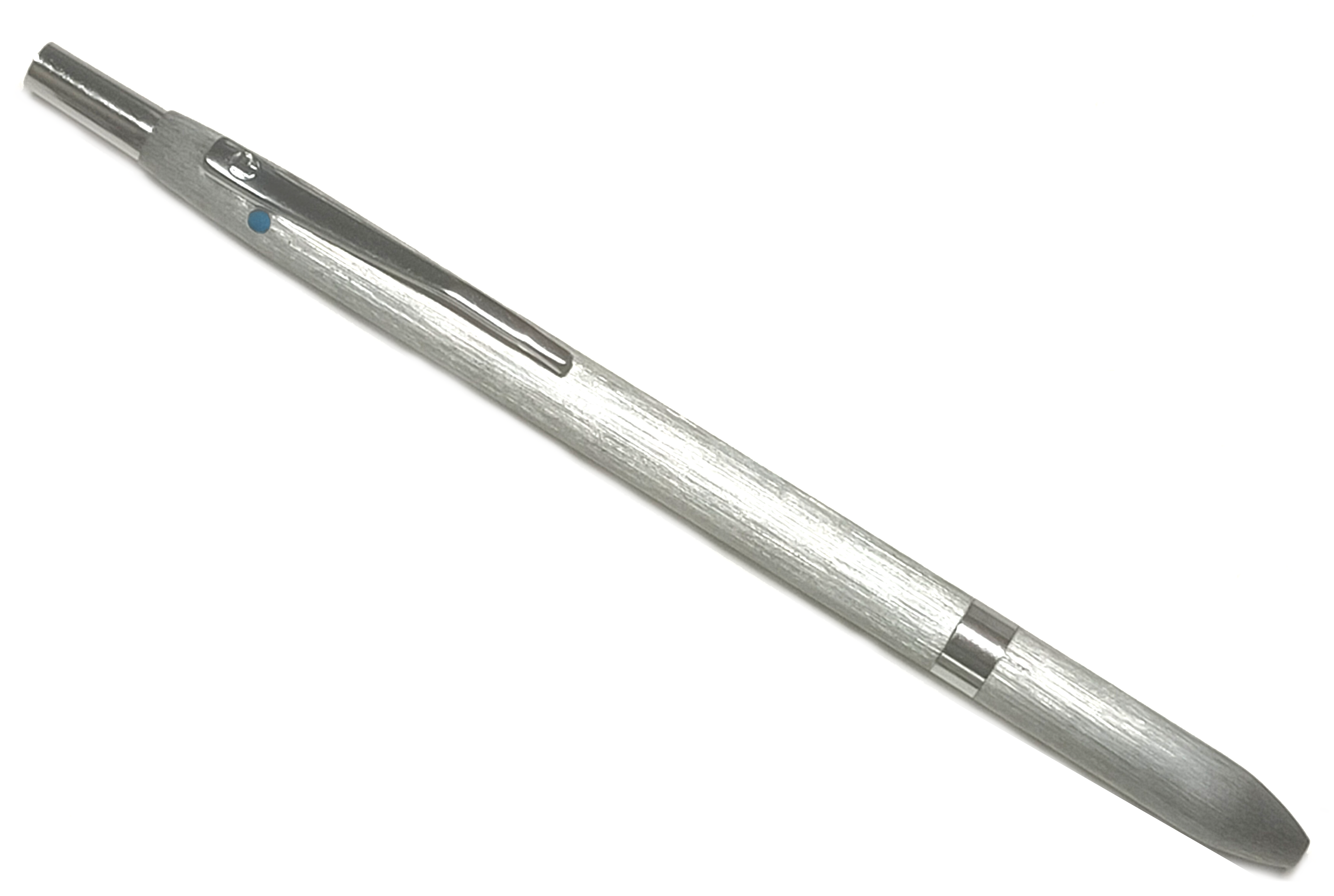
- Manufacturer of the world's thinnest four-color ballpoint pen (8.1mm OD).
- Manufacturer of the first Montblanc four-color pencil in 1929.
History of the company
With particular reference to multi-colored pencils
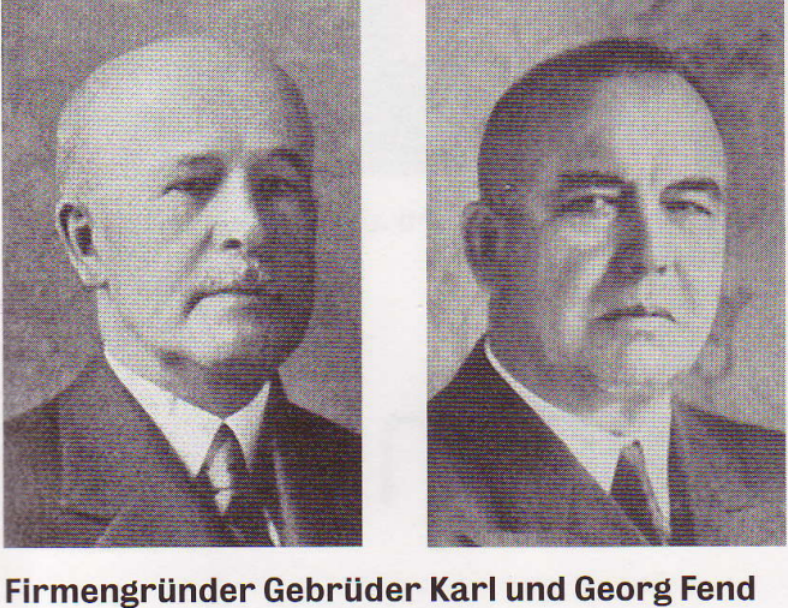
On May 1, 1900 theCompany Gebr. Fend Crayons Factoryin Pforzheim at Weiherstrasse No. 26 by the brothersGeorg and Karl Fendfounded.While Georg was a businessman, Karl specialized in technology as a trained pencil maker. And so they made their own with just a few thousand marks Metal pin factory.
The factory's first documented product was drop pins, registered in 1901.
This was followed by our ownMechanical pencils, fountain pens, as well as combinations of fountain pens and mechanical pencils.
They were made of both noble and base metals, and at least in 1910 the materials galalith and hard rubber are also documented.
In 1905 Goldschmied came acrossHeinrich Fendin addition.
On September 15, 1905, Georg and Karl entered into a general partnership, which Heinrich later also joined.
1909 became oneBranch in Nurembergfounded. Oskar Härpfer, himself an inventor and manufacturer of mechanical pencils, was responsible for this. Procuration granted.
Gustav Fend, originally a painter, managed the branch in Nuremberg. In 1912 he also joined the company.
In addition to writing instruments, a range of products was also offeredeveryday itemsconstructed. These ranged from beauty and personal care items such as Toothpicks, combs, powder compacts, lipstick holders, knives, lighters and thermometers.
Your essential efforts and also the financial support from the Pforzheimer BankGreb & Frühaufhelped the company quicklygreat success.
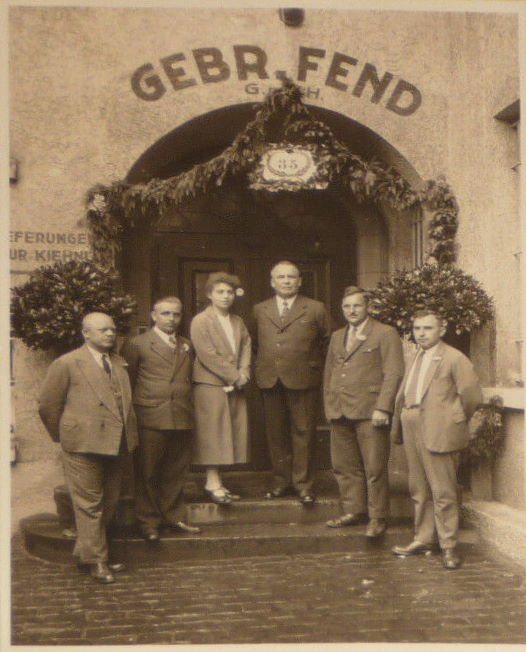
They had to move several times for capacity reasons, so they were later also located on Dillsteiner Strasse, Kiehnlestrasse, and Enzstrasse, where they were already able to employ 120 people (before 1918).
Even before the First World War, the Fend company had already established itselfsettled abroad several times; In France (Paris), Switzerland (Vienna) and Italy (Milan).
But the main buyers at that time were not only southern Europe but also South America and Russia. Germany played a subordinate role.
1918 after the warCarl Jaißle, businessman, became a partner in the company and headed the export department.
A sales office was set up in Birkenfeld near Pforzheim, where 100 people worked.
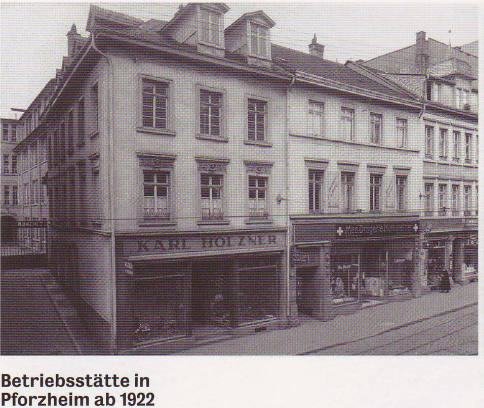
On June 30, 1922, a new factory at Leopoldsplatz Pforzheim was purchased for 1,300,000M. This corresponded to the LGB. 153, 154e and 155.
In 1923 the factory on Leopoldplatz at Westliche 66/70 went into operation.
Go this yearKarl, Georg and Heinrich Fenda social contract. The company Gebr. Fend Crayonsfabrik becomes one Limited liability company (G. m. b. H.) with all three as managing directors. The share capital was 6,300,000M.
Furthermore, Carl Jaißle received the power of attorney.
The following year the OHG was announced as dissolved.
1929 marks the year of Fend's first patented multi-color pencil.
They made this as an advertising pen, but also managed to get Montblanc excited about their invention, which was the Fend pen in the same yearfirst multi-color pencil in the history of Montblancin a 2- and add 4 color variants to your range.
Until 1930, the Fend company withstood all crises thanks to good foreign business. However, the global economic crisis did not, as a result of which layoffs had to be made this year.
A four-color pen created new hope for the company: TheFend Norma, patented by the famous inventorAlbert Hirthin December of the same year 1930.
Albert Hirth was already 72 years old at that time and died just 4 years later.It was his last invention.
One assumption is that Hirth Fend sold the manufacturing license on the condition that his company "Albert-Hirth-AG" should supply the necessary special machines.
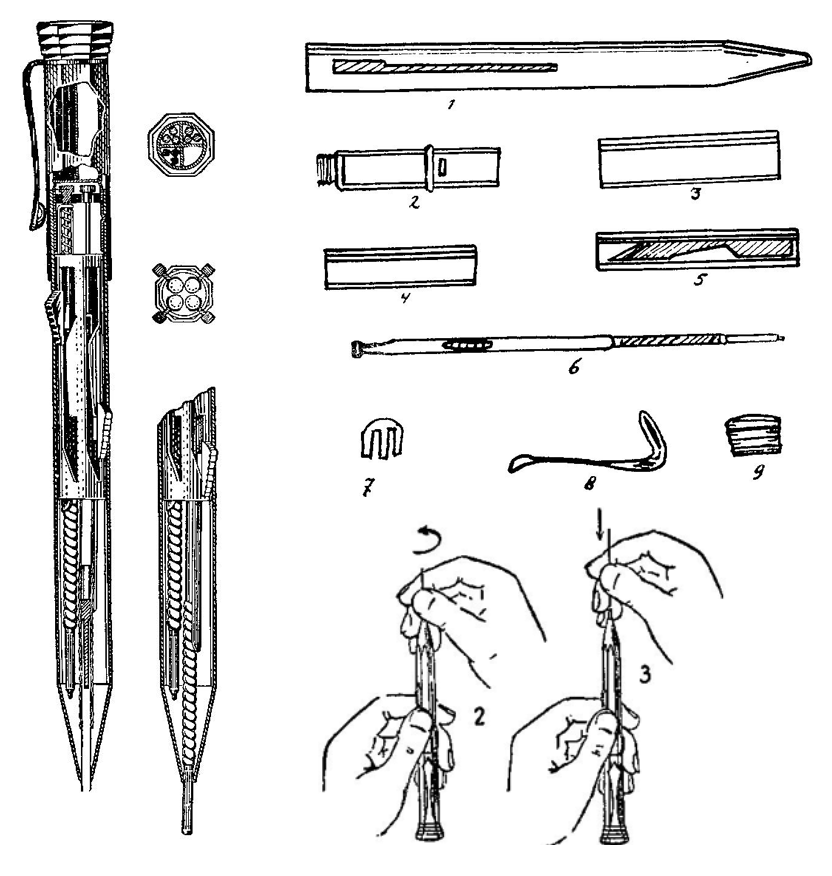
The structure of the Fend/Hirth Norma was very simple:
When the lead holder slide is pushed down, a tongue snaps into an opening below the slide slot, which secures the lead holder in writing position. The locking opening is close to the writing opening, which allows the operator to press in the tongue with the hand holding the pen without having to reach around too much. whereby the lead holder is moved back into the pen by a compression spring.
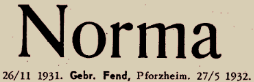
The trademark 'Norma' was registered under the Fend company, not by Albert Hirth, in 1931.
It is believed that the name 'Norma' may have come from Hirth's ball bearing factory of the same name. As is usual with pens, the name was usually on the clip.
Instead of 'Norma', the names can be found on the clip abroad'Colorgraph'(Italy),'Pour'(Great Britain) and'Dictator'(Switzerland).
Versions with the name were also released within Germany'Stoffhaas'and'Goldfink'made for the stationery stores of the same name.
Most likely based on the Fend Norma"Norma Multicolor"from the USA their own version, which was patented there in 1935 by Hans Maucher (USA).
Hellmuth Hirth, one of Albert's sons, gave away the "HM 60" (HM = Hirth engine) to the oldest employees in 1936 to celebrate the thousandth from his company “Hirth-Motoren GmbH Stuttgart Zuffenhausen” a silver Fend Norma.
The company in question donated another pen to the appropriately small number of participants in the “Schwabenflug 1937” on May 29, 1937. This was a regional, multi-day flying event that had existed since 1909 and was organized by the Aeroclub Baden-Württemberg, its most important sponsor At that time Albert Hirth's other son, the aviation pioneerWolf Hirth, war.
Died in 1932Gustav Fend.
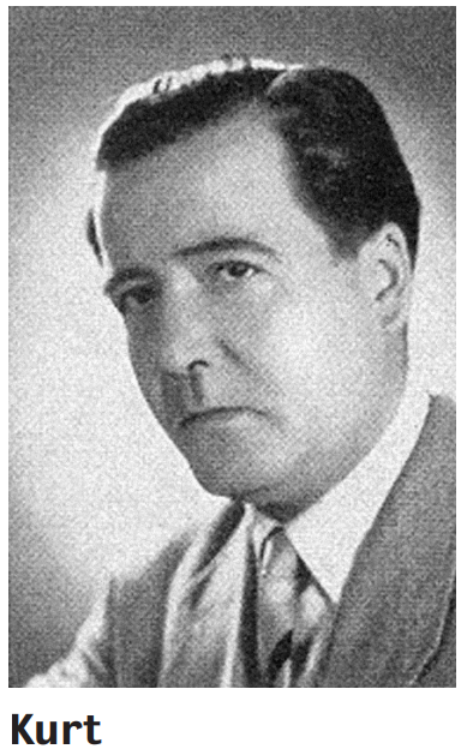
Building on the Norma, the vonKurt FendinventedSuper Normapotentially one of the greatest successes in the company's history: The locking sleeve automatic was first used in a multi-color pen installed for easy color changing. It allowed the deployed mine carrier to withdraw automatically slightly pushing down one of the other sliders. Pens with such a mechanism were often given the description "automatic" or "fully automatic".
In the previously mentioned countries where Norma was spread, the Super-Norma also arrived and spread even further.
In Switzerland the 'Dictator' was appropriately named the Super-Dictator (registered in 1938 as trademark number 93250).
In France, JIF used the mechanism with the Panta four-color ballpoint pen, and in Italy, for example, Universal.
In Japan it was a pen from the 'Kanoe Peace' range (which didn't just consist of multi-color pencils). This was manufactured by Morita Metal (森田金属製作所), for whom there is evidence of the use of the Fend patents, so Morita has established a connection to Fend would have to.
Goldfink also remained loyal to Fend; A Goldfinch Super-Norma was a birthday present from Adolf Hitler to Friedrich Braun in 1944. Especially given the strained relationship For Hitler and Braun, it is noteworthy that a multi-colored pencil was seen as a fitting gift.
In the same year, 1936, the Fend company became a limited partnership. At that time, Fend employed almost 500 people.
The founders resigned between 1936 and 1938George and Karlback and handed over the companyKurt Fendand Carl Jaißle.
On February 2, 1939, Heinrich Fend resigned as a liable partner.
In 1941 there was one for the first timeBerlin branchproven. This was located in SW68, Schützenstraße 31, and was represented by Wilhelm Ley. It still existed in 1943.
Died in 1944Heinrich Fend.
AmFebruary 23, 1945The Fend brothers' factory in Pforzheim was destroyed.
The Milan branch also fell victim to the war.
Georg Fenddied a few days later in the air raid on Kupferhammer (Pforzheim) on March 4, 1945.
Karl Fenddied of a serious illness in autumn 1945.
So all four Fend brothers had died.
Despite all this, she decidedKurt Fend and Carl Jaißle, to rebuild production in a rented, converted gym in Huchenfeld. The commercial office was set up on Simmlerstrasse.
Since the machines had to be built, repaired and procured again, the production of multi-colored pencils could not be resumed for at least 3 years be approached earlier.
The continued high demand, including from abroad, could not be met with the old sparse stocks.
So it happened that in the years after 1945 in countries such as Switzerland, France, Spain and Portugalimitators to reproductionthe multi-colored pencils Fends made.
From 1948 onwards, production was back on track and by that year 160 people were employed in the new factory.
Single-colored and multi-colored ballpoint pens were newly added to the range. As with other manufacturers, the switch to ballpoint pens was not abrupt and For a while, the same models (e.g. Super-Norma) were produced in colored pencil and ballpoint pen versions.
I have 1. May 1950 tractCarl Fendinto the management after becoming a general partner in 1948 and in the past as an authorized representative and field sales representative had already worked for the company.
Now he took care of the domestic business, while Jaißle took over the foreign business.
1950 was alsoKarl Eberhard Fendbecame a partner after he returned from captivity in 1949 .
This year 50% of production was destined for export.
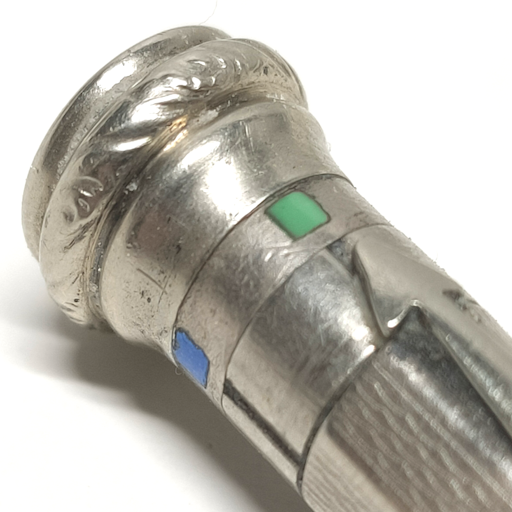
With the company's new beginning also came a new design for its writing instruments. The caps lost their nested shape, and the clips became more square. In this decade, Fend began using the old cursive logo in parallel with a simple 'FEND' in capital letters.
In 1954 the number of employees was over 200 and it was decided to move back to Pforzheim to Gymnasiumstrasse 79, which they did between June 1st and 7th, 1954 the building permit was granted.
At the beginning of 1955, the impressive building could already be occupied thanks to modern quick construction methods.
It was a five-story main building measuring 53x12 meters, a three-story rear building measuring 36x12 meters and a glass hall 36 meters long, which was intended for heavy, high-vibration machines. Faceted box girders designed for air protection made column-free halls in the main building possible.
Died just 2 years laterCarl Fend and Carl Jaißle, whereupon Karl Eberhard took over full commercial management.
Around 1958, a third of production was destined for foreign countries, exported to the USA, East Asia, Africa and Europe. This was the domestic business in comparison probably became more present in pre-war times.
During these years Fend got its first and lastmajor redesign. In addition, people were moving more and more away from cardboard boxes and towards plastic ones.
It became theVisual election ballpoint penError 500 (Server Error)!!1500.That’s an error.There was an error. Please try again later.That’s all we know.Tilt of the penparticular.
Kurt Fend had invented such a mechanism 20 years earlier, but it was significantly different from the finished product.
It can be speculated that both the war and the additional development time required could have been reasons for the long time between patent and product.
Around 1960Carl-Jürgen Fend, toolmaker, and Dieter Wolfgang Fend, businessman,formally joined the company. In 1960 neither appeared in the address book, but in 1965 both appeared together.
Carl-Jürgen was in his early twenties, and Dieter must have been too. The family relationship has not yet been clarified.
At the beginning of the 1960s, advertising was expanded even further and several new brands were registered. Some of them had a French sound, which should either sound generally good, or perhaps they tried more intensively on the French market.
OneCombination of ballpoint pen and caliperwas introduced. This combination pen was designed as part of theDeafseries sold.
They were probably inspired by the design of the flat mechanical pencilCanoe-Peaceseries collected by Morita Metal.
But it all seemed pointless because around the mid-1960s, business began to collapse again, for the first time since the Great Depression.
The reasons for this are still unclear.
In 1972, Fend became Carl-Jürgen Fend GmbH, and some of the existing brands were changed to this, the rest was deleted.
The company's history takes an unpleasant turn here. Dieter Wolfang and Carl-Jürgen apparently decided to close the factory building and the to minimize production.
In the same year Dieter left Germany.
Carl-Jürgen continued to run the company as the last owner, but to what extent is still unclear.
Died in 1976Karl Eberhard Fend.
August 2, 1982 marks the 'official'End of the Fend Normawith the expiry of his trademark.
The company still existed in the 1990s, but it is said to have only had one employee. What else was manufactured and distributed is not yet known.
In 2000, the first and only patent was registered by Carl-Jürgen Fend. It concerned a continuation of what had already emerged in the 1960s Combination of ballpoint pen and caliper. In addition to the two basic functions, a table was created, a profile knife and a voltage tester were designed. However, the latter did not make it into the realized product.
Sold todayCleo Writerthis so-calledMessograf.
The intended name for the messograph was probably 'Messo-FAS', as this was the company's last registered trademark in 2002.
In 2002, the trademark protection for 'Fend' expired automatically after non-renewal.
Around here, or earlier, Carl-Jürgen must have emigrated following Dieter's example.
On July 5, 2004, Carl-Jürgen Fend GmbH was liquidated.
Carl-Jürgen Fend died on June 26, 2024 at the age of 82.
The Fend company was also characterized by great loyalty to the factory: in 1937 and 1950, among others, workers were honored for their many years of service. In 1950 there was one employee with 47 years of service.
Notes
- Heinrich was part of the general partnership in 1923, but in 1905 only Georg and Karl were named.
One source speaks of 1907 instead of 1905, but here too there is no evidence.↩ - Gustav also talks about 'joining the company', which is why it seems as if he, like Heinrich, must have become a partner. But I haven't found any evidence of this yet. Furthermore, one source contradicts the year 1912 and states 1917, after Gustav Fend returned from the war.↩
- After payment difficulties and all sorts of allegations of embezzlement and the like, Karl Fend fell out with the bank in 1915. The information about financial aid comes from a blocking response letter from the bank, so it must be viewed skeptically given the context.↩
- According to newspaper articles, the branch abroad, including in Milan, happened before the First World War.
However, it was only later that it became noticeable through the entry for 'Fratelli Fend di E. Fend' in Italy's commercial register and the trademark entry 'Fendograph' (1936).↩ - This information can be checked in 'Collectible Stars I'. I don't own the book.↩
- According to another source, Carl Fend only 'came back' in 1949. Could he still have been registered as a general partner in 1948?↩
- Possibilities:
1. Carl jr., Carl and Karl Eberhard all three came back from captivity around 1949, with Carl and Carl jr. In 1950 they both joined the management team Karl Eberhard only joined in 1957.
2. Carl Jr. was never involved and there is an error in the newspaper article in which Carl Jr. the speech is. Only Karl Eberhard became a partner in 1950.
3. Same as 2, except that Karl Eberhard only became a partner in 1957, after Carl Fend and Carl Jaißle had died.
Why should one be selective in the book source Carl Jr. not mention and not mention Karl Eberhard in the newspaper article? Carl Jr. must have been very young, which does not contradict the fact that he was a prisoner of war, but does make partnership implausible. Do you know more about this?↩ - As mentioned, it is unclear whether Karl Eberhard first became a partner here and what Carl Jr.'s role was (see other footnote).↩





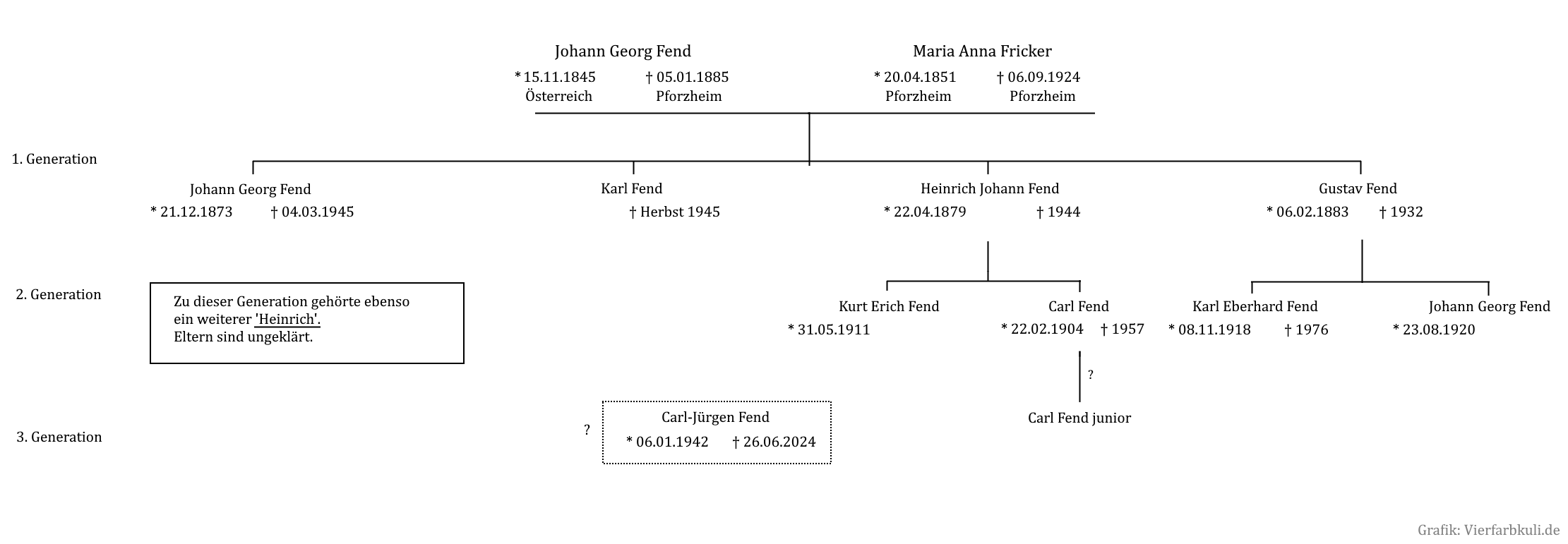 This image is my creation and is incomplete.I welcome corrections and additions.